

by
Hillthorn
Developer Fool Moon, Finnegan Motors • Publisher Raw Fury • Release November 10, 2026 • Reviewed On PC
Blood drips from my wounds and from the axe I carry. Racing for my life on multiple layers I stumble through the winding trails of Hillthorn mountain back to where it all began. A trail and day I have stumbled through numerous times. If I don’t reach something, anything, soon, the clock will hit midnight and the nightmare will begin again, stitching up my flesh and undoing my murderous act. But hope for freedom, currently a roaring fire, will be snuffed out.
With minutes to spare until the clock strikes twelve, I lunge towards a park ranger at the base of the peak. Babbling, I try to explain the horror I’ve unraveled in a confused mess.
Enough gets across that I find myself in a car driving away, alive though scarred, from the terror of my looping life.
The credits rolls. Relief. I’m saved, though I have regrets. At least I made it out. I might have the keys to everyone’s occult jail, but I’m not sure if I can make the choice to go back now.
It was never really a choice.
I can’t keep myself from facing down the mountain trails, even if I have none of my hard-won prizes. At least, I chuckle at the gallows humor of it all, I have my memory.
Hillthorn may be one of the most unique detective experiences I’ve ever enjoyed. A large part of its ingenuity coming from the fact that the story above, the one I lived through in the game’s three-hour runtime, unfolded almost entirely through cards.

Still, with limited visual cues, my imagination remembers every step I took vividly. It takes an extraordinary narrative framework to summon so powerful a theater of the mind. It also demands intuitive, frictionless card mechanics, which is one of Hillthorn’s biggest strengths.
The developers take all these disparate ingredients — a Majora’s Mask-like loop system where you lose all your items at the end of a day, a time mechanic that moves forward as you interact with the world à la The Séance of Blake Manor, Metroidbrainias’ knowledge as progression mechanism, and deck building as the main action-driver — and deftly combine them into a game I just couldn’t put down.
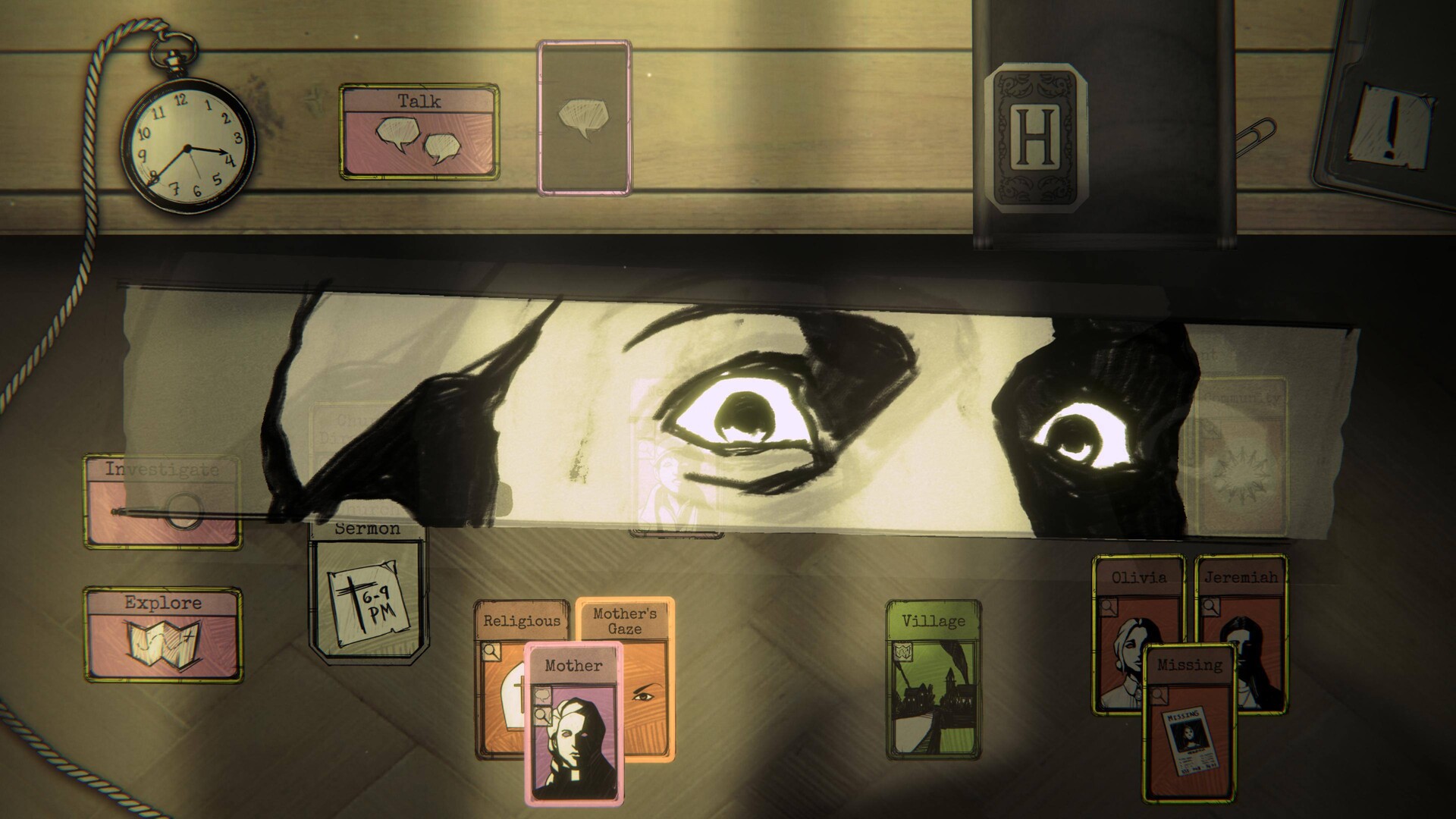
Trying to explain the moment-to-moment action may fall short of experiencing it for yourself, but I’ll attempt to lay down the basics. Upon beginning, players get thrown into the unique card interactivity without outside prompting, pushing them to pick up on the systems when the stakes are low.
There are a few types of actions you can take, which correspond with certain cards. These are helpfully color coded to help identify them immediately. Orange signifies the card can be investigated by placing it in the slot at the top and pushing the magnifying glass. This examination may result in other cards, new scenes, fresh objective, or more leads to follow.
Similarly, green cards allow you to move to different areas, while purple cards represent people you can talk with.

I can’t stress enough how intuitive the system becomes after getting your bearings. Sometimes placing a card in the action slot will cause a second slot to appear, meaning you can combine two things for another result.
For example, slotting in the drunk patron of the inn, I can choose to simply try to talk to them, or I can use the newly appeared second slot to hand them a beer, which I received previously in the game. In this way, every interaction, every investigation, every narrative setup, is a puzzle built on top of a puzzle that is just so gratifying to spot and solve. Of course, when you do, you open up another mystery.
There are common irritations that come along with the time loop genre. Uncovering a big reveal in the last few minutes may mean not getting the reward of solving the puzzle because the clock resets directly at midnight, and you have to do it all again to truly reach the end of the thread.
However, the team has done a remarkable job at limiting frustrations by granting players “shortcut” cards. If you’ve unlocked a safe in a past run, the game gives you the combo again which you can just input. If you have continuously completed actions, like picking up coins at the bar, you’ll receive a card that lets you skip the steps and gives you the coins.
Hillthorn is one of those rare investigation games that make you feel clever and uncertain simultaneously. It’s mechanically brilliant, allowing players to focus on the narrative’s occult twists, the investigation’s thrilling unpredictability, and the joy of piecing together its unsettling puzzle.
Recommended For
- People who enjoy puzzle games
- Armchair detectives
- Those not ready to give up spooky season
- Card enthusiasts
- Fans of smart games that make you feel smart
Leave a Reply