

by
Denshattack!
Developer Undercoders • Publisher Fireshine Games • Release July 15, 2026 • Platforms PS, Xbox, Switch, PC
A few months ago, I wrote about Denshattack’s Steam Next Fest demo. I wasn’t shy about my praise for the game, and I felt satisfied leaving that demo having learned exactly what the game was. Now, having played the full game, I’m disheartened to stand before you and admit I was wrong. Turns out my confidence was actually naivety because, surprisingly, Denshattack! is not as good as I originally thought in my earlier preview. It’s way, WAY, better.
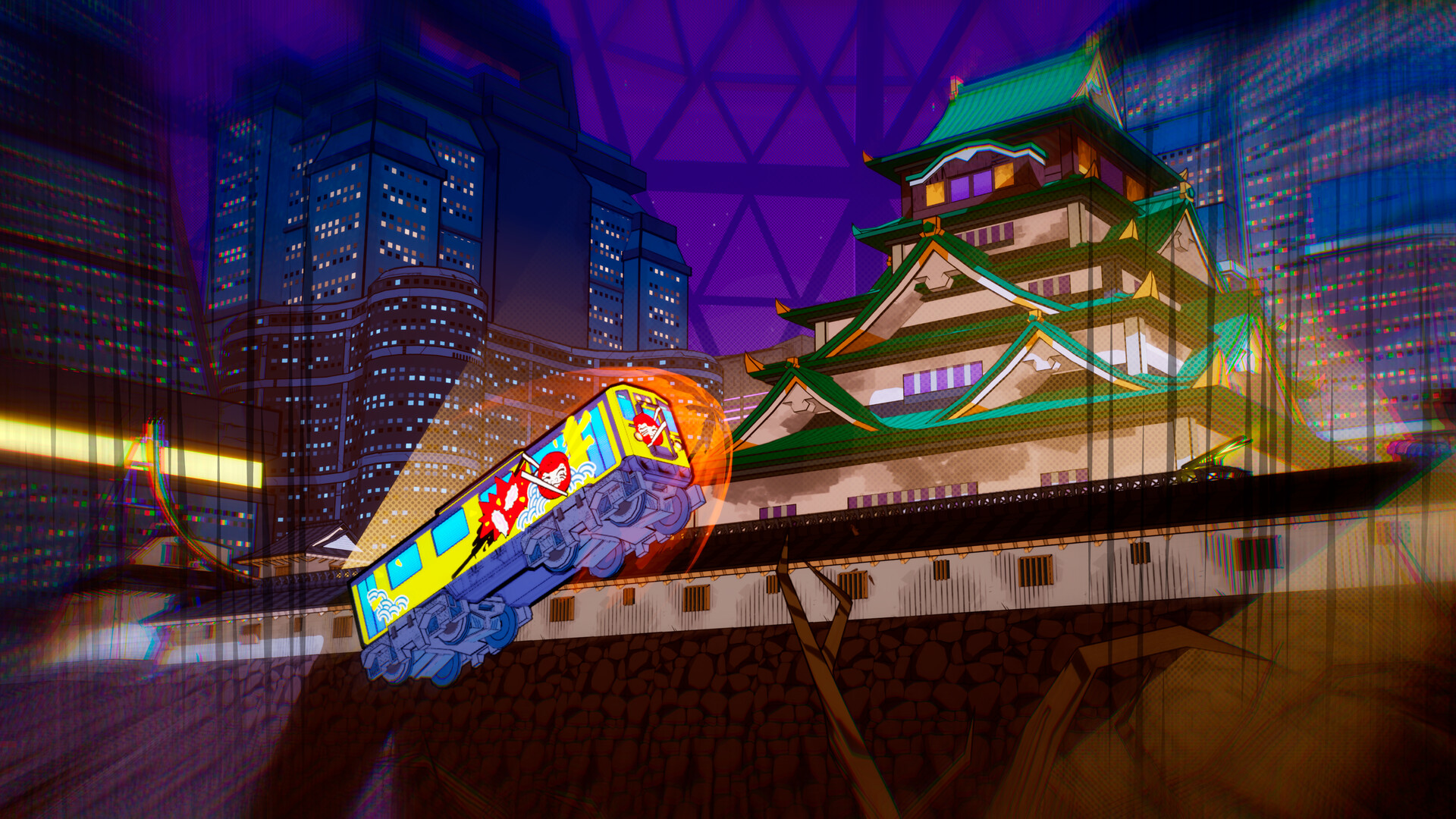
Denshattack! reminds me of that mosquito preserved in amber from Jurassic Park. As a ’90s kid, it almost feels like a perfect snapshot of a bygone era. It is literally the modern interpretation of how I remember the games of my childhood. The visuals, music, level design, and gameplay all strike unique notes seldom present in modern games, and the more I played, the more it became apparent this game was going to be something special.

As you venture out on your journey to become an expert Denshattacker, you interact with various crews across Japan who stand ready to test your might and teach you the tricks of the trade. These story moments are depicted as still, comic-like panels, often (and somewhat randomly) accompanied by varying degrees of voice acting and animation. The character designs are fun and somewhat nostalgic for anyone familiar with anime archetypes, but surprisingly, these are some of the weakest aspects of the game. Not because the story itself is bad, but because the gameplay does an infinitely better job of selling the world and the absurdity of the events within it. I always found myself itching to skip the rather predictable dialogue and jump into the next wildly unpredictable level.

The levels in Denshattack consistently up the ante without fail. You are repeatedly presented with new moves, new environmental hazards, and bizarre gameplay gimmicks to keep things interesting. It reminded me of old 3D Sonic levels that somehow managed to keep the concept of “blue character goes fast on a mostly linear level” interesting by throwing killer whales and runaway streetcars into the fray. There’s this constant balance between mechanics and level design that is expertly managed. As you learn new abilities and moves, the levels get out of your way and give you room to breathe and commit the new information to memory. Shortly after, the game cuts you loose and lets you experiment with your tools in fresh and creative ways.

From a technical standpoint, the game explores so much more than the demo showed. Not only can you use your train to grind, but you can also wall ride, manual, go off-track within tunnels, and even trigger a secret rainbow road-coded bonus track to guide you through alternate paths in a level. This isn’t even half of it, as the bag of tricks initially seems never-ending, with each region (or chapter) introducing a new ability to play with.
As for the standard trick library, it might just be my lack of familiarity with the genre, but from what I’ve seen, the list of available tricks does seem somewhat smaller than in other games I’ve played. That being said, a novice like me could never dream of committing even half of the moves in this library to memory, though I have a feeling more veteran players will max out the list rather quickly.
There are multiple opportunities to customize your playstyle, though, as you eventually gain the ability to swap your train for one with different attributes by purchasing it from a store unlocked early in the game. I honestly found many of the customization options to be a little lacking, but it was never a major issue, as I had no issue sticking with the original train design and the few customizations I clicked with.
I’d be remiss if I didn’t touch on what I consider to be expert-level design. This is the secret sauce of the game. There are dozens upon dozens of levels, each themed around the region they reside in. Not only do they serve as great skate levels for Denshattackers of all skill levels to shred on, but they also ooze personality and novelty. There’s something to be said about how the designers fused the culture and feel of these real-life Japanese locations with the anime-inspired absurdity layered over everything.
Some levels are simply tracks weaving through the city and countryside, with a banger soundtrack blasting confidently to set the mood. These take the form of not only linear tracks, but also open-track areas where you must complete several tasks across the level, or tangled trick levels where the goal is to score a specific number of points within an allotted time.
Many levels also feature a set-piece moment, whether it’s escaping a mechanized sandworm, participating in kabuki theater, or playing some odd mutation of baseball with a rival. The best part is that you never know what you’re going to get, and even when you do, no matter how many times you replay those levels, the magic remains.
In a time when many games build on trendy genres or spread themselves thin trying to be the game for everyone, Denshattack commits to a concept and does everything it can to take it beyond your wildest expectations. It somehow surprised me over a dozen times within just the first couple of hours, even when I was sure I had a solid grasp of everything it was attempting to do. It’s a fine-tuned experience that delivers on the exact promise it made when it was first revealed and then goes a little further. It almost sounds blasphemous to say, but it’s a game so good at depicting speed and slick movement that it might even give the blue blur a run for his money.


Leave a Reply