
Developer Little Bat Games • Publisher Little Bat Games • Release 2026
Cyrus Nemati is best known as the voice of Ares and Dionysus in Hades, but in 2024, his own studio, Little Bat Games, released its first title – Vampire Therapist. The surprisingly ambitious narrative game had you indeed playing the role of a therapist, untangling centuries of emotional baggage packed into immortal beings. And it was developed in cooperation with experts to help implement real therapy concepts.
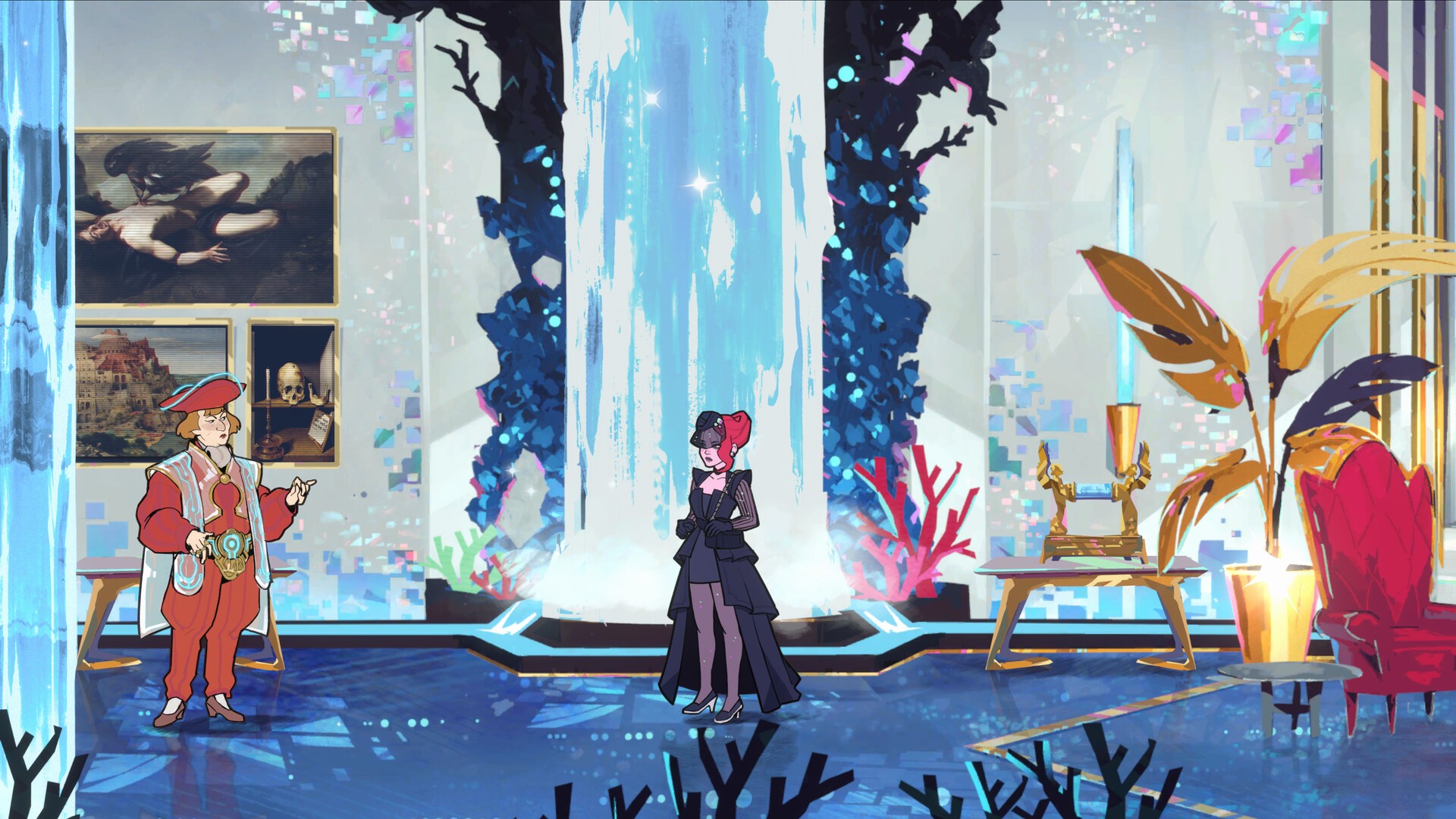
Now, Nemati and Little Bat Games are ready to take on an even bigger narrative challenge – wealth inequality. Better Than Us is a “social stealth” game where you play a thief, gaslighting the ultra-wealth out of the money they’ve stolen from everyone else.
It’s a game clearly inspired and defined by the world (and America’s) current moment – but equally by the cyclical nature of history. I had the chance to sit down with Nemati and really dig into Better Than Us’ inspirations, aspirations, and how games can meet the moment of society and culture.
I’m curious, where did the idea for Better Than Us come from? It has some elements of Imposter Games.
Nemati: Yeah, actually, no. It wasn’t inspired by any games. The nice thing about our approach is that we start with punch lines for the most part. And, you know, where there’s historical precedent as well.
One of the things about Little Bat Games is that we are starting with history first as a way to really reflect on where we are. So, where the origin really came from was from Elon Musk: as an American, seeing this financial takeover of what our system of government is, got me thinking. Of course, there’s nothing I can do about that. It is what it is, and I’m not a billionaire. I have no control over it. But when has this happened before? Have we seen capital concentrated to this level before?
I dug into history and found this particular character from 500 years ago, and then started researching, and all of these parallels really started to ramp up. Once you have this much money, there are so many things you can buy that are not mansions, not sports cars, but buying authority, spiritual authority, buying temporal authority. It was this rabbit hole I kept on digging.
I had this idea for a game a while ago, a sort of social stealth game where it’s not about sneaking, but really remembering what you said throughout the game. I thought I’d like to give it a try, and this scenario ended up being a really nice wrapper for it.
And who was that character from 500 years ago?
Nemati: His name is Jakob Fugger. And yes, it was originally “fucker.” It was, I think, 150 years later. But yeah, he was, he basically set up the modern trade equivalents that we had back in Germany 500 years ago, which is very convenient, because I live in Germany now.
Little Bat’s previous game, Vampire Therapist, was also heavily researched. Is that kind of research-driven development integral to the studio’s identity, and why is it an approach you wanted to take?
Nemati: For one, it’s a different sort of approach, like we’re actually not doing anything hugely novel, except for talking to experts. One of the things that I find about it is if there’s a field where there are experts and they’re not really paid attention to, it’s not something people are picking up journals and reading what they’re writing. Games are a way to open up this kind of understanding and dialogue, and they’re [experts] are always so happy to be involved. They just want to talk, and will answer my questions endlessly. So why not take advantage of these resources?
I also think it makes our worlds feel a lot more believable. We have a trailer out for Better Than Us already, and one of the most gratifying things I see about the responses is that people aren’t viewing it as sci-fi; they’re viewing it as our future, which really speaks to that research aspect. It’s because it’s been done before, that’s why it feels so familiar.

What has your historical research process looked like for this game? Because even on other historical games, like Total War, it can look very different.
Nemati: It’s been quite a lot of reading, a year of reading. It started from this initial point of who this character is and what influence they had, and just spread out from there. Because what happened was basically a realignment of society.
So it’s been a lot of reading, but actually a lot of travel as well. I’ve been travelling all over Germany to see where these events took place, and talking to locals about how they still talk about these characters that have been dead for a long time. In the United States, probably our most similar analog is Henry Ford. We don’t talk about him, really, but we probably should. Because he was the most effective American Nazi, and contributed more to Nazism than anyone in terms of financial support.
But the thing about this character [Jakob Fugger], I go back to places where he was and talk to people about him, and they have a much more positive opinion about him, because he did proper philanthropy. He did those sorts of philanthropic acts, and that is a big difference between what we’ve got now and then, even though there are all these similarities.
So immersion has been a really big thing for my team and me, going on different trips and recognizing these things that they don’t teach kids in school.
You talked about the idea of “social stealth,” but how do you create a social stealth system in such a heavy, dialogue-based game, like Better Than Us?
Nemati: I’m going to reveal the thing that is going to make people hate the game in some aspects, and that’s timers. Yeah, I know, I have to do it, because this is what creates the tension. Basically, what I’m simulating is the idea that you have to think on your feet with the characters you’re speaking with, and there are always timers. They’re always waiting for you to know what to say – so there’s no looking it up to see, ‘Oh, what did I say about this topic or that?’
You have to keep it in your head. That stress is intentional.
Not only that, but based on the character you’re speaking with, some of them may be more or less patient. The analog for this is the Jakob Fugger character, who is very business-minded, so if something is not oriented toward making him more money, even on the microscopic level, he doesn’t want to hear it. So his timers are uncomfortably quick.
But that discomfort is actually the whole point of the game. We’ll have accessibility modes to reduce or even get rid of the timers, but this is the social stealth that I want to emulate. You have to be thinking on your feet as quickly as possible.

From a writing perspective, how difficult is it to write a story around the idea that the player has to be lying and remembering those lies? How hard is it to thread that throughline?
Nemati: It’s very hard. One of the ways I try to mitigate the difficulty of it is by making the lies not all that significant. It’s about creating consistency. So we don’t have things like big branching narratives – I don’t have the time or the skill, or even the belief, frankly, that people are going to be playing through these things multiple times.
So what I’m doing is making sure that each of these questions is something that can be answered in a vacuum, and that makes it easier for me to manage. Not entirely, because I still have to keep in mind how often I need to test the player on what they’ve said, and even whether to test them, because that’s part of the experience as well – you’re not going to be tested on everything. So that’s part of that tension of creating, what is this person going to ask about? What do I need to remember, versus what’s insignificant?
You’ve worked a lot as a voice actor, and I’m curious how that has influenced your approach to game design. Like has working on, say, Hades, influenced you?
Nemati: Hades is definitely the one. Because I think what it taught a lot of game developers is that often what matters is not necessarily that the player needs to feel they’ve changed the world. They just need to be acknowledged.
When I’m designing a game, I’m trying to think about how I can acknowledge every single action they take. It’s almost a very data-driven approach, where we’re keeping track of every time a punch happens, or every time a player is making a particular decision. Then we reflect back, and said, oh you tend to do this, or tend to do that.
Something as simple as that can make things feel engaging for the player without, again, branching narrative, where you often are writing two or three games in one that most people won’t see. So I find the acknowledgement part of it is really helpful.
You know, as a voice actor too, getting to see how development works at different studios is really educational. I learned early on in my career that if voiceover happens early in a project, it means the rest of it isn’t going anywhere. Because voice-over is something you can just jump in and do, and it’s fun and feels engaging. There’s an order of operations to game development that I think I got a nice broad look at as a voice actor. Because you show up, do the lines, and then your relationship is over.
Obviously, you have these very prescient themes of the ultra-wealthy and how that affects culture. But what are you hoping people take away from Better Than Us? Beyond just bringing these things up, what are you hoping to impart?
Nemati: Well, it’s all in the title. Really, Better Than Us is something that these people believe. If you’ve read the Palantir manifesto, this is definitely built into it.
We can reward billionaires for being billionaires and saying it’s not because they were lucky, or not because they had privilege, or not because they were in the right place at the right time. Even in that manifesto, they talk about how you can do everything online, but you can’t. You have to be in California because you have to talk to the right investor, or have to be at the Slush Festival in Finland, where all these ghouls are hanging out.
So I think what I want people to get is that nobody is better than anyone else. This is the communitarian approach that I want to lay out. It’s not about one side dominating the other, but the fact that we’re all the same. It sounds very simple, but we do forget.

Along those same lines. You describe Better Than Us as a “dark comedy.” How do you tread the line between comedic writing, but also making sure it feels weighty and realistic?
Nemati: A lot of it is that comedy is a diffuser. So the more difficult the topic you’re talking about, that’s when diffusion is even more important. And it can have different forms, like in Vampire Therapist, what I used is the dopey cowboy protagonist who will always boil things down, sometimes in profound ways, and sometimes in incredibly stupid ways.
I’m hoping to do the same thing with this game, where I let these characters talk, I let the player be horrified, then I let them do something about it. In this case, the diffusion is sometimes the sarcasm that will be happening whenever you’re talking to a character that has clearly gone off into some crazy place – and there’s a sidekick character you have that is able to reflect on a number of things. But again, it’s that being able to diffuse the extremely difficult conversation that comedy is necessary for, and giving them both room to breathe is really important.
Video games are situated in a lot of societal issues right now. Do you think games, in particular as a medium, have more potential to comment on cultural or social issues? And if so, are they fulfilling that potential?
Nemati: I think games are in a really excellent medium for being able to engage with these sorts of topics. Very often, games — and much more in this era of AI and 25,000 games a year out on Steam — we have this opportunity to do something other than copy other games.
The way I view game development, or the way I view players, is as an audience, before I see them as players. This is a very old tradition that when you have an audience, you want them to feel something in particular, not just engaged, not just satisfied, but have a particular feeling around what they’ve experienced. And we can be doing this, and we can be challenging players in unexpected ways, not just in terms of gameplay but in how they’re thinking about and approaching a game.
I think we’re going to see that as so many games come out that are trying to lower the friction level as much as possible. I mean, what I’m relying on is that there will be a demand for higher-friction games. This is definitely one. It’s a different kind of friction, but I think friction is the only way we learn. It’s the only way we remember the experience we’ve had. If it’s completely passive or it’s something like a second-screen sort of game, we’re not going to remember any of it. And I think that’s what’s necessary to be competitive now.

Oftentimes, we love to categorize games beforehand, and I think people are going to look at Better Than Us and assume it’s a visual novel. How do you communicate a unique game like this and break through the noise?
Nemati: Sometimes it’s framing. For instance, it looks very visual novel right now because not all of the assets are in, but we have parties that you can walk around in, there’s a physical avatar and animation. But it will feel like more of a place that you’re in.
The other aspect of it is that I have to do a better trailer. I had the same problem with Vampire Therapist, where I said what the game is, but I needed a second trailer to show how the game is. That’s what I’m working on right now. Once we’ve got our lie interface fully bolted in, then I’ll be able to show what it does look like when you’re having to recall these lies, and what it looks like when you can’t
But I do also have a little exclusive. We’re actually working on two games at the same time.
We’re going back to Vampire Therapist. Not Vampire Therapist 2 yet, but we’re making some standalone content that will be updating some of our gameplay and doing some polish. We have a really interesting first story, and I hope a stacked cast if I get who I want. It’ll actually be out before Better Than Us because it’s very easy to produce.
When I made Vampire Therapist, I had just learned to code, and it was very messy. It still is, but now one of the greatest difficulties I’ve found was that I actually couldn’t add more DLC to the game because the voiceover files took up so much space. So basically, I’m starting with a new framework that will allow me to add content to this particular game as often as I like, so we can do stories for as many as we like. And since they’re cheap to produce, I think it’ll be a nice, sustainable thing that’ll allow us to talk about, again, stories that people aren’t talking about.
Leave a Reply