
Developer Chaos Theory Games, Seismic Squirrel • Publisher Seismic Squirrel • Release March 30, 2026 • Played On PC
There’s no shortage of games out there that fall into the various Punk genres, the most well-known obviously being Cyberpunk and Steampunk. But far too often, those genre labels simply serve as visual and aesthetic styles, and games lose sight of the arguably more vital half of the title. Six hours with Aether & Iron has blissfully proven that to not be the case, as the game has slowly reeled me in with superb writing and a gripping world that oozes class tension. It’s a game that feels markedly different from anything else out there, and I’m dying to see where the mystery goes.
Aether & Iron is a “Decopunk RPG,” and if you’re not familiar with that specific sub-genre, it’s a sleek retro-futuristic style that revels in the designs of the 1920s-1950s: times of great technical innovation, luxurious fashion, and great societal upheaval. The most obvious example that exists in video games is BioShock, if that helps you visualize. Decopunk often focuses on opulence and extravagance, society at its very peak, before everything comes crashing down. As you might expect, weath and greed go hand-in-hand with that.

In the world of Aether & Iron, the discovery of a mysterious chemical called Aether has led to the greatest innovation the world has ever seen. With it, humanity has taken to the sky, creating massive floating megacities filled with wondrous technology and flying cars. But amidst this civiliation more division than ever has started forming, particularly in the greatest city in the world, New York. Massive cities like New York have been turned into a multitude of Baronial Estates, where rich and powerful barons command their own armies, pass laws, and influence how society works.
On this tapestry, you play as a smuggler named Gia, who’s taken a job that’s immediately gone sideways, having to babysit an academic who’s stumbled into the lower, dangerous parts of the cities. As she helps her client, Gia is pulled into a political conspiracy that affects the entire city.
What I find so immediately fascinating about Aether & Iron is how quickly it lays out the rules and framework of its world. In this world, occupations have essentially turned into their own distinct social classes, like cab drivers having their own settled area and way of life. Amidst all those classes are “Aethoneers,” the engineers responsible for keeping up the technology of the floating cities, who are all relegated to the dark technological pits of the cities that don’t see sunlight. Society has taken to calling these people “Aether Rats.”

Within the first two hours of Aether & Iron, I stumbled into a parade for the Baron of White Street, one of the major floating islands. As the crowd cheered, a protester appeared to throw a Molotov Cocktail, and within seconds, the Baron fired a massive beam weapon and incinerated not only the protester but the entire area and building around him, killing countless others in the process.
From the very beginning, Aether & Iron sets its stage with bloodshed, and I’m amazed at how the game unflinchingly tackles the inequalities and violence of this society — obviously a mirror into real economic inequality. Aether & Iron doesn’t just use the city of New York as an interesting setting, but the Big Apple’s real history as a backdrop. And the number one thing that’s drawn me in so hard is the quality of writing. The best comparison I can think of is like listening to some kind of illustrated noir mystery.
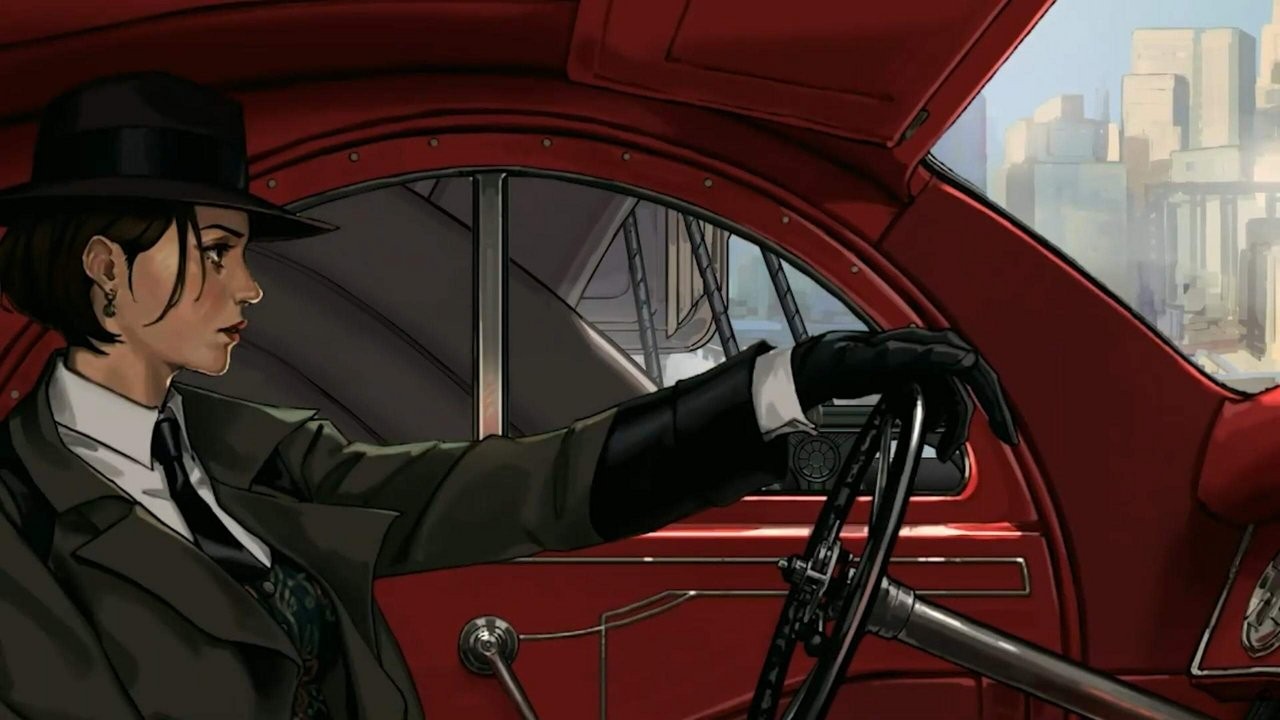
While Aether & Iron is a role-playing game, it veers more into adventure game territory, as it’s extremely heavy on dialogue and decision-making. The entire thing plays out with Gia as a narrator, in the exact same vibe as a noir detective. This approach fantastically blends with the Decopunk story to create something that really stands out, giving the writing a personal edge that helps propel the narrative. Gia herself is an immediately likable protagonist, a smarmy and cocksure character happy to play it fast and loose with the rules of this world. Aether & Iron’s art style is also absolutely stunning, hand-drawn human art that makes each area look like a painting. In the best way, it reminds me of so many of the adventure games of the 1990s, which, with a lack of animation, relied on imaginative landscapes and details to sell a sense of immersion.

While the majority of what you’re doing is narrative-based, Aether & Iron does feature turn-based vehicle combat. Each party member can outfit their vehicle with a variety of weapons and enhancements, with an AP gauge dictating the actions you can take. But there’s a lot of thought put into the actual mechanics of how these fights would work within the city. Apart from the core combat mechanics, you’ll have to deal with citizens driving on the road, cabs, construction, and changing lanes. It’s a bit like a more historical version of that flying car chase from Star Wars: Attack of the Clones.
The other added elements here are dynamic inventory management that has you juggling important story items with car parts and consumables, and a dice roll system that gives you checks during dialogue. For example, getting stuck at a checkpoint, with contraband in your trunk, if you’ve invested in Charm, Gia might be able to bat her eyelids and sweet-talk the guard.

But what I find most impressive about Aether & Iron is how engrossing it all feels, despite, admittedly, being rather simple. So much of the presentation is static screens, but the art is so eye-wateringly attractive that it’s hard to care. At times, it can feel more like a visual novel as the RPG elements take a back seat, but the entirely voice-acted script and rich writing make that hardly matter. Story and thematic ambition are the things at the forefront in Aether & Iron, and while I might like a few more really mechanical elements, it’s hard to fault the game for doing what it does well. And most importantly, I’m tremendously glad it tackles the “punk” piece of its genre right out of the gate, and never forgets about it.
Aether & Iron is one of my biggest surprises of the year, and if it can keep the quality up throughout the journey and stick the landing, it feels destined to become something of a cult classic.

Leave a Reply