
Developer Wishes Unlimited • Publisher Klei Publishing • Release 2024 • Played On PC
In an early conversation in Beastieball, your crusty mentor Marlin asks, “You ever watch sports anime?”
The player has three response options, “Yes,” “No, why?” and the line I select, “I don’t believe in sports anime.”
“Well, you best start believin’ in anime, kid,” he replies. “You’re in one.”

Beastieball has a simple premise: what if Pokémon (or, in this case, Beasties) liked to play sports instead of fighting? The result is a game structurally similar to Pokémon where the combat is swapped out for an original, turn-based, volleyball-esque game. After six hours with a preview build, it’s become one of my most anticipated releases for the end of the year. Between the matches, the world-building, the writing, and the Beasties themselves, developer Wishes Unlimited is working on something special.
The video game Beastieball is named after an in-world sport all Beasties love and intuitively know how to play. Humans can assist, but they don’t really own or adopt the creatures; they befriend wild Beasties, gift them a jersey, and train them up in the sport to compete for fun or in ranked leagues.
As the protagonist, you’re tasked with taking a team of Beasties to the top of the league’s rankings to stop the local nature reserve from being demolished to make room for a new stadium. It’s a charming, heartfelt story, and, if the aforementioned anime line didn’t clue you in, extremely goofy. After picking your starting team, you venture off into the world to challenge other ranked coaches, and while some roadblocks in the preview build prevented me from entering some areas prematurely, you can generally challenge bosses in any order, and they’ll appropriately scale in difficulty.

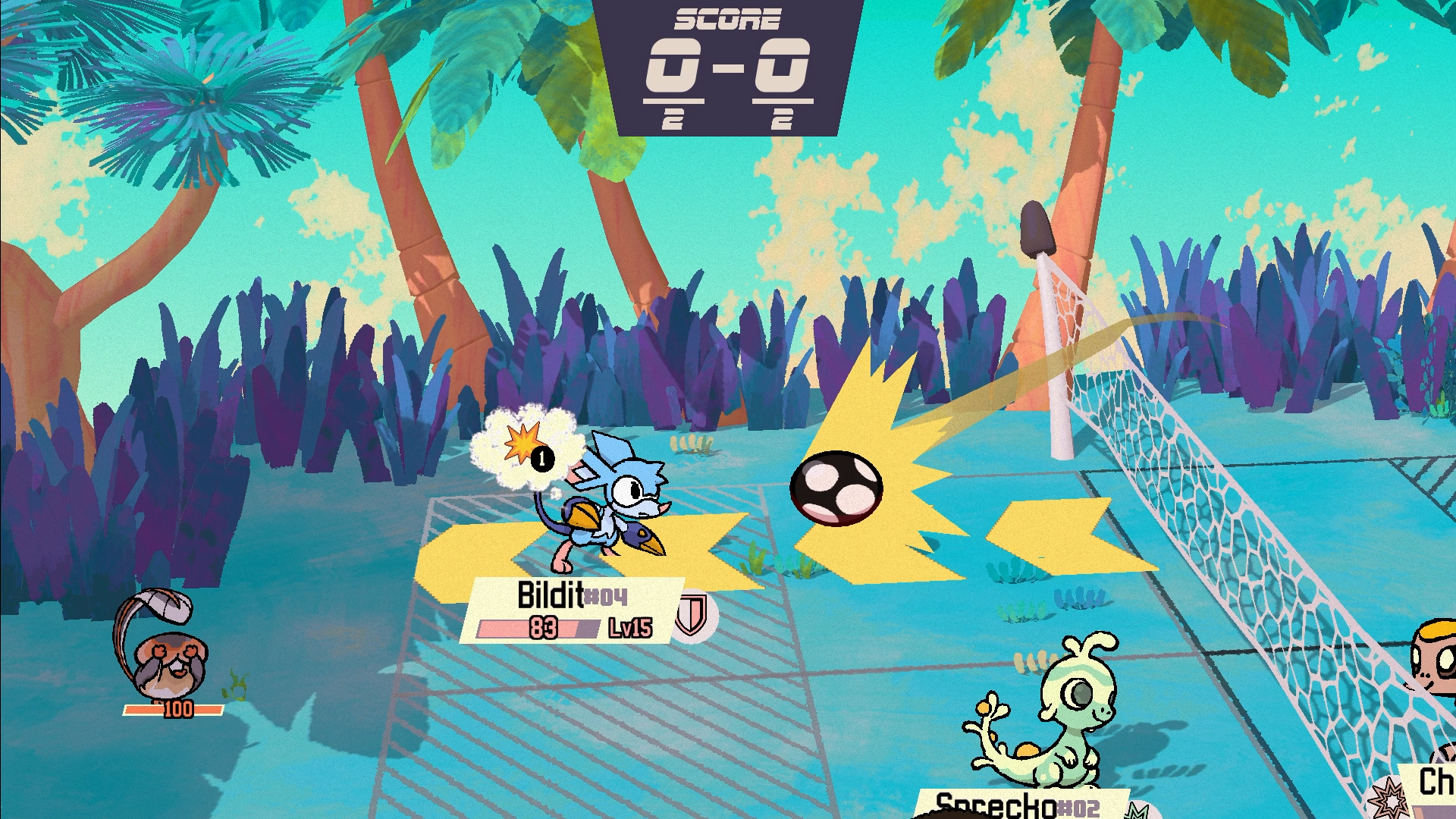
Beastieball matches themselves, whether you’re facing off against other coaches or Beasties in the wild, are thrilling. It’s a turn-based system with each team positioning two Beasties on their side of the net. When you have the ball, you get three actions, which can be used to make offensive plays, use support abilities, or move the monsters around the field. Each side has a front lane, where you deal and receive more damage, and a back lane, where your team starts each turn. While you can win points by striking the ball at opponents to deplete their stamina, you can also score points by hitting the ball into an empty lane, and thanks to some moves that send the ball in unexpected directions, your positioning matters as much as your health bar. And while Beasties have three different offensive and defensive stats to calculate attacks and damage, the rock-paper-scissors style of elemental types is absent here, forcing the player to think tactically about their plays instead of defaulting to “fire beats water.”
To build up a team, you’ll need to recruit some critters in the wild, which is a fun mechanic in and of itself. It’s more than just throwing a ball; Beasties each have a unique recruitment condition that you must fulfill to coax them over to your side. Some require points to be scored a certain way, some want a certain stat raised by a certain amount, and some want to see certain moves, but every requirement is unique, so you have to commit to get the Beasties you want. Additionally, while you can recruit as many as you like, in Beastieball, you don’t “gotta catch ’em all” – you can see the whole game no matter how full or empty your Beastiepedia (yes, that’s what it’s called) is, so don’t feel pressured to nab every monster you meet.

Beasties also have individual personalities that cause them to form relationships with their teammates. Sprecko, one of my earliest recruits, is Partners with Daredillo and Besties with Handicoot. Depending on who Sprecko is on the field with, my team will have access to a different combo move. If they spend enough time playing together, they can learn moves from one another, and even take their relationship to the next level. Sprecko and Handicoot spent a lot of time together, then started getting Nervous (a status condition that prevents you from moving) when playing at the same time. After a few games, they realized their true feelings, evolving their relationship from Besties to Sweethearts. Adorable!
When an indie developer does its own spin on an existing, believed franchise, it’s taking a bit of a risk. Change too much and you might lose what made the original so special; change too little and you’ll risk feeling like a cheap copy. But in the best-case scenario, like in Beastieball, you change just enough to make the formula fresh, fun, and unique, while preserving enough of the source material to preserve the nostalgia that made fans fall in love with the tropes to begin with. I’m thoroughly impressed with what I played so far, and I can’t wait to get back out onto the field when the game enters Early Access later this year.
Leave a Reply