
Developer Headware Games • Publisher Headware Games • Release September 12 • Played On PC
Silent Hill 2 has been fogging up my brain. I recently completed my first playthrough of the original game in preparation for Bloober Team’s much-anticipated remake. I finally understand first-hand what makes Konami’s flagship horror franchise special, and homages such as this year’s Crow Country have paid loving tribute to the series in ways I appreciate more in retrospect. Hollowbody is the first Silent Hill-inspired game I’ve played with full context for its inspiration. Although it’s an enjoyable homage, its thematic and storytelling shortcomings gave me a greater appreciation for Silent Hill 2’s sky-high narrative prowess.

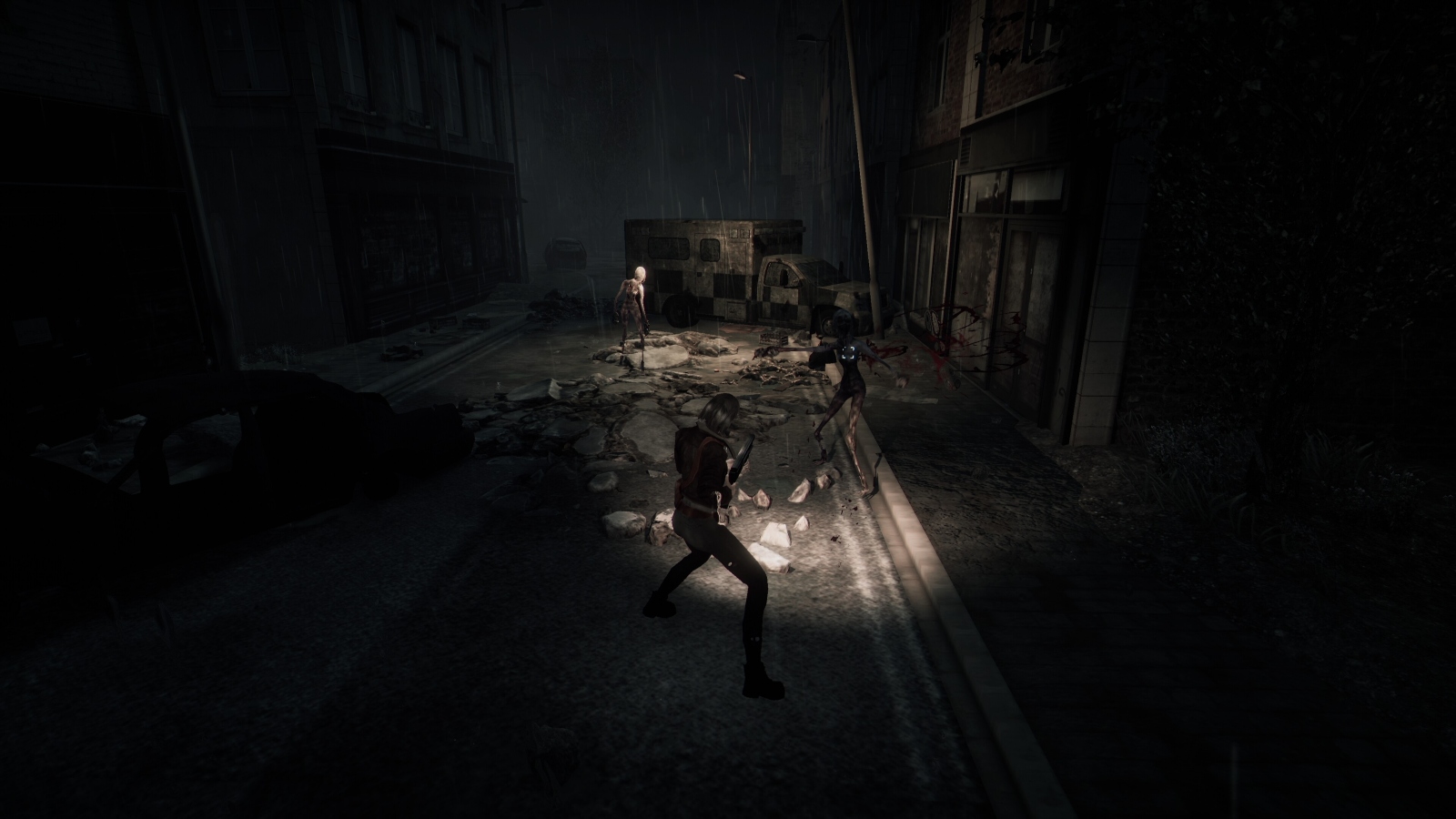
Hollowbody’s mid-21st century setting lends it a distinct identity thanks to cutting-edge flourishes such as hover cars and retro-futuristic overlays reminiscent of Blade Runner. Players control Mica, a woman tasked with rescuing a friend trapped in an abandoned city in an exclusion zone devastated by a mysterious blight. When Mica becomes stranded, her mission becomes a fight to survival that plunges her deeper and deeper into the belly of a dangerous beast.
The game proudly wears its Silent Hill inspirations on its sleeve. The desolated city is divided into small, open hubs teeming with grotesque flesh monsters. Getting close to these creatures triggers a static-like sound effect – a nod to Silent Hill’s radio. Fixed camera angles trade the freedom of viewpoint for cinematic or devious perspectives designed to create maximum tension or surprise. Tack on well-paced save terminals and inventory management, and Hollowbody is a checklist of PS2-era survival horror hallmarks. Even its presumably intentionally dated presentation is straight from the early 2000s. However, it also has some of the era’s less savory-level design flaws. My biggest headache is the abundance of invisible walls blockading what often appear to be visually accessible environments.

These familiar elements make Hollowbody feel like survival horror comfort food. Even at its “Intended” difficulty setting, I never found it challenging or overtly terrifying. It has a strong, foreboding vibe, but none of the creatures had me cowering in fear. Perhaps it’s because many are easy to avoid, making it easy to build up a surplus of ammo for the game’s two main firearms: a pistol, and a shotgun. Several melee weapons, from a spiked 2×4 to a street sign, rarely saw use. However, the wrestling fan enjoyed bashing threats with a guitar like the second coming of Jeff Jarrett.
Thankfully, the puzzle-solving has a lot more bite to it. The classic song and dance of gathering and combining mundane items to open locked areas remains effective here. More elaborate riddles, such as locating the right cemetery headstones to open a church trapdoor, are generally clever without being obtuse.

Silent Hill 2’s storytelling is fascinating for its layered symbolism and chilling representations of heavy mental health themes. I can’t confidently explain Hollowbody’s plot or meaning, but not because it presents some profoundly thoughtful mystery. It’s just needlessly vague. As far as I can tell, the town has fallen victim to a deadly plague or virus…I think. If you asked me whether this threat was a man-made bioweapon, an alien pathogen, a supernatural force, or the manifestation of Mica’s subconscious, I would reply “Yes”. The only insight comes in a mysterious figure who periodically contacts Mica to whisper vocally distorted hints and threats. These conversations often go nowhere (and last longer than I’d like, diluting the mystique), with the voice speaking in riddles and Mica largely addressing it like an annoying inconvenience rather than a potentially threatening foe.
The more I played Hollowbody, the more I realized it feels closer to the abundance of Silent Hill (and Resident Evil) imitators that sprung up in the late ‘90s and early 2000s. Games that, in some cases, nailed certain aspects of what made those series special while falling short in other departments. Hollowbody executes enough familiar elements well to be mechanically enjoyable, but it never gripped me with its scares or narrative. The result is a solid and succinct (roughly five hours) romp for those looking for a less foggy but adequate appetizer ahead of Silent Hill 2’s modern encore.
Leave a Reply