
Developer Attu Games • Publisher Attu Games • Release TBA • Platforms Xbox, Switch, PC
Even from the start screen, I’m in love with Scarlet Deer Inn. The woven pastoral scene features huggable sheep, shifty geese, swaying trees, and — to top it all off, a lone flautist embroidering the landscape with a soft and haunting tune. Getting to know the world further only strengthens my initial impression. The feudal hamlet is replete with small-town authenticity, genuine characters, and, of course, a deeply unsettling narrative left-turn that I’m still getting over.

But let’s linger in the sleepy medieval village for just a few minutes before delving into the dark places of this world. The main character, Elise, lies in a sparse, but clean, room. Awakened from her sleep by her young son, she makes his day by retrieving Horace, the toy horse, from an unfortunately tall shelf. The moment is sweet and serves several purposes.
One, it gives me a quick rundown on how to interact with the world and its inventory system. Two, shows a glimpse into the emotionality of the story, and to do that in just a few lines bodes well for the rest of the game. Three, it sticks the toy itself in my mind, which will become important later. It is effective and efficient game design.
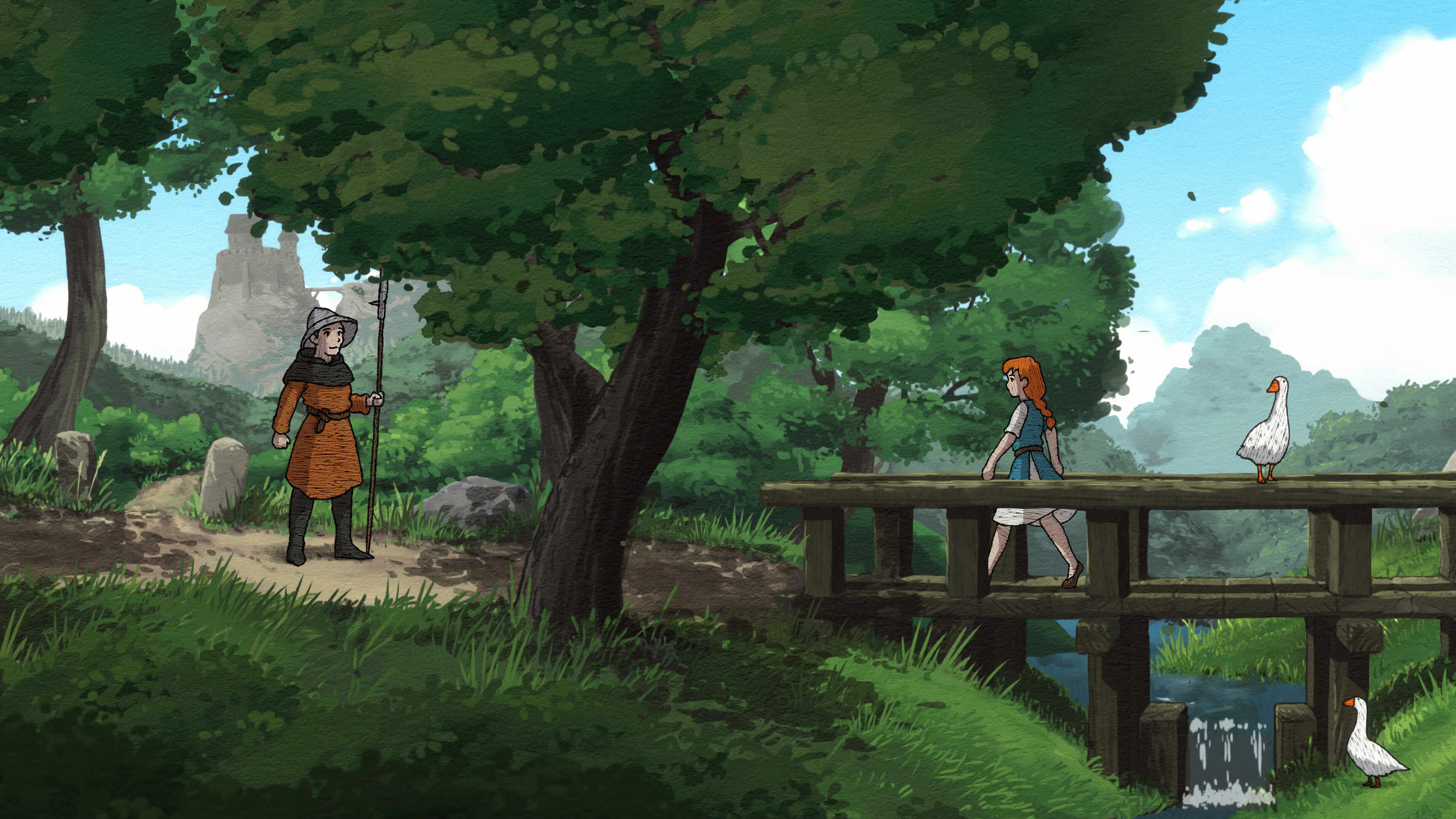
I’d also like to highlight one immediately apparent and impressive thing: The masterful use of the game’s unusual medium. During last year’s introduction, Scarlet Deer Inn was praised for its unique art style which blends actual sewn characters with more tradition game graphics. Though the choice could have been simply a gimmick, its importance is stained into the title’s very fabric.

It took several minutes for me to leave the beginning room because I couldn’t get over how fluidly the characters moved. Elise’s hair whips back and forth when running and comes to a momentum-filled halt when I stop. It’s striking to see thread flowing this way. On top of that, the dialogue boxes incorporate textile elements and very quickly impart familial connections and socio-economic status.
A successful business owner, Elise’s text box consists of pale fabric with a red, detailed border. Her less fortunate neighbors get rough burlap to display their words. Meanwhile, a well-traveled merchant staying in the inn is distinguished with a purple-dyed and intricately embellished dialogue base. Its a small detail, but one brimming with great information.

Again, my forward progress was soon halted by another discovery. Almost every animal is the town is petable! So far, the list includes cows, geese, sheep, and a donkey. And I’m ready for more. While roaming the countryside for other creatures to pet, I did also manage to find time to walk the golden path.
One of its first stops is a falsely sweet old woman. We’ve all known this woman in the real world. She’s doing me a favor — making a tunic for my child — so I can’t object to any of her snide remarks about the quality of the drink I offered as a thank you gift. And I can’t say no when she asks me to run a few quick errands for her while she finishes up “the last few stitches.” So, off I go to drop off and pick up a diverse handful of items — each with special instructions attached.
But I don’t complete my mundane list of errands.

Looking for the recipient of a piece of cake, I stumble into a den of deception, death, and the supernatural. This was not on my bingo card for the demo, and it had me literally shout “oh, hell no” at the screen. The narrative beats are perfectly timed. This sudden switch leads into the more action-based section of this playthrough which could use some tweaking.
I’m happy believing my critiques are things that can probably be fixed even before the demo gets into some players’ hands. Most pressingly, I desperately need more interaction prompts. While some are heralded by a floating X to let me know I can hit the corresponding button to do something, many times, I didn’t know I could walk through a gate or light a torch simply because there was no hint I could. A button pop-up, a shimmer effect, or a well-placed lantern could go far in helping me navigate what to do.

Another element I believe can be swiftly adjusted is timing. After the game’s narrative twist, I have to contend with some time-constrained segments which are admittedly intense in a very cool way. I love the anxiety-inducing heartbeat that indicates time to complete my task is running low. But the length of the timer doesn’t perfectly consider how unfamiliar with the mechanics and design most demo players will be. I believe addressing the prompt communication issue will help with timing enormously, and I’m hopeful a few more seconds of leeway will conserve this section’s intensity while mitigating frustration.
Often, I take notes as I’m playing a game to help me recall how I was feeling during my playthrough. The last two entries under Scarlet Deer Inn conclude with both an exclamation mark and a question. One is an observation on the games audio design freaking me out. The other — the very last scrawl interpreting my hurried thoughts — questions the nature of the world. Smartly, the demo doesn’t answer my final question, leaving me wanting to know what the hell is going on and where are we going from here. It’s exactly what I hoped for.
Leave a Reply