
Developer Aggro Crab • Publisher Aggro Crab • Release April 25 • Reviewed On PC
With its adorable protagonist, tough themes, and even tougher boss fights, Another Crab’s Treasure has been one of the indie scene’s most anticipated game. And when I’d finished a handful of hours, I began to worry I’d have to explain why I didn’t like it. Thankfully, the pearl at the title’s heart began to shine brighter by the end of my experience.
The creativity is truly delightful — the puns alone put the writing in another league — and I rapidly fell in love with the world and Kril, the story’s mistreated central crustacean. But like the gunk invading the title’s underwater realm, I found myself early on weighed down by technical aspects resulting in frustration that threatened to drown out everything else.

It’s not often I explore a game’s weaknesses before getting to what makes it great, but I wanted to structure this review to mirror my in-game experience. Don’t despair. The good is coming. However, the lack of technical polish is particularly glaring in the first half of the game and never completely goes away. Frustrating moments where the camera clips through a wall so I can no longer see what I’m doing or a fight getting derailed because I or my opponent get stuck in the geometry are unfortunately common.
Worse, however, are the details that felt plain punishing. I can’t tell you the number of times I strained my every nerve reaching a high platform only for a grunt to casually push me off. To give due credit, the team did work to mitigate this by ensuring falling off a cliff didn’t kill me outright but rather took a chunk of health and returned me to the last solid ground I touched. But if the fall wasn’t long enough to kill me, I was just stuck at square one.

I also throw into this category a few of the early bosses — though I want to highlight this gets much better as the game goes on. One big baddie in particular seemed to be near-untouchable for my poor wimpy crab. It boasted poison attacks — which could drain my health and slow my movement — long range hits, up-close crushers, moves that would send me across the room stunned, an instakill that felt impossible to avoid. On top of that, it only took me one, maybe two, good hits to go down.
I’m no stranger to Soulslikes and enjoy a good challenge, but this fight almost broke me. Which is why I have no problem admitting that I turned to one of the game’s most fantastic features: Assist mode. Scroll on over to the setting menu sometime, and you’ll find a great spread of options to help overcome challenges. These range from tweaking the opponent’s health to giving the player a larger parry window. It will even outright put a gun in your hands to send those pesky challengers to sleep with the fishes. It’s perfectly absurd and satisfying.
Absurd and satisfying is a pretty good description of almost everything else in the game. The inciting incident involves a fake loan shark stealing my home for my supposed failure to pay taxes. And for all the silliness in that concept, I honestly feel for Kril. The voice performances are great and really sell the drama as I watch my cute character slowly lose himself in the cold, unfeeling ocean.

The themes get surprisingly heavy. Rage and depression both find their way under the microscope, and the game takes a good, compassionate look. Perhaps not shocking considering the title, waste, the environment, and greed are also large parts of the narrative. The subjects are prominent but not preachy and mostly come through via relatable dialogue with characters you grow attached to along the way.
Combat is likewise deeper than some will expect. More Sekiro than Dark Souls, fighting encourages strategic stance-breaking rather than button mashing. Consequently, the shells I pick as my shield play a big role in my success. Parrying is essential, and most shells come with unique spells to further unbalance a foe. Does it help that these vital tools can take the form of rubber duckies, skulls, or yogurt cups? Yes. Yes, it does.

My protective gear can only take so much before it breaks, which pushes me to explore a wide variety of shells and shell spells. On top of this — literally — are Stowaways that can further customize my fighting build. Some boost attack damage, some increase resource regeneration, while others can provide a petable friend. If that wasn’t enough, I also gained powerful specials called Adaptations after beating certain bosses that drain my Umami — like magic but ocean-themed. But wait, there’s more! There are ways to upgrade Kril via skill tree and discoverable Umami masters which grant me powers like a running jump and tools like a grapple hook. Most of these help not only with combat but also in exploration.
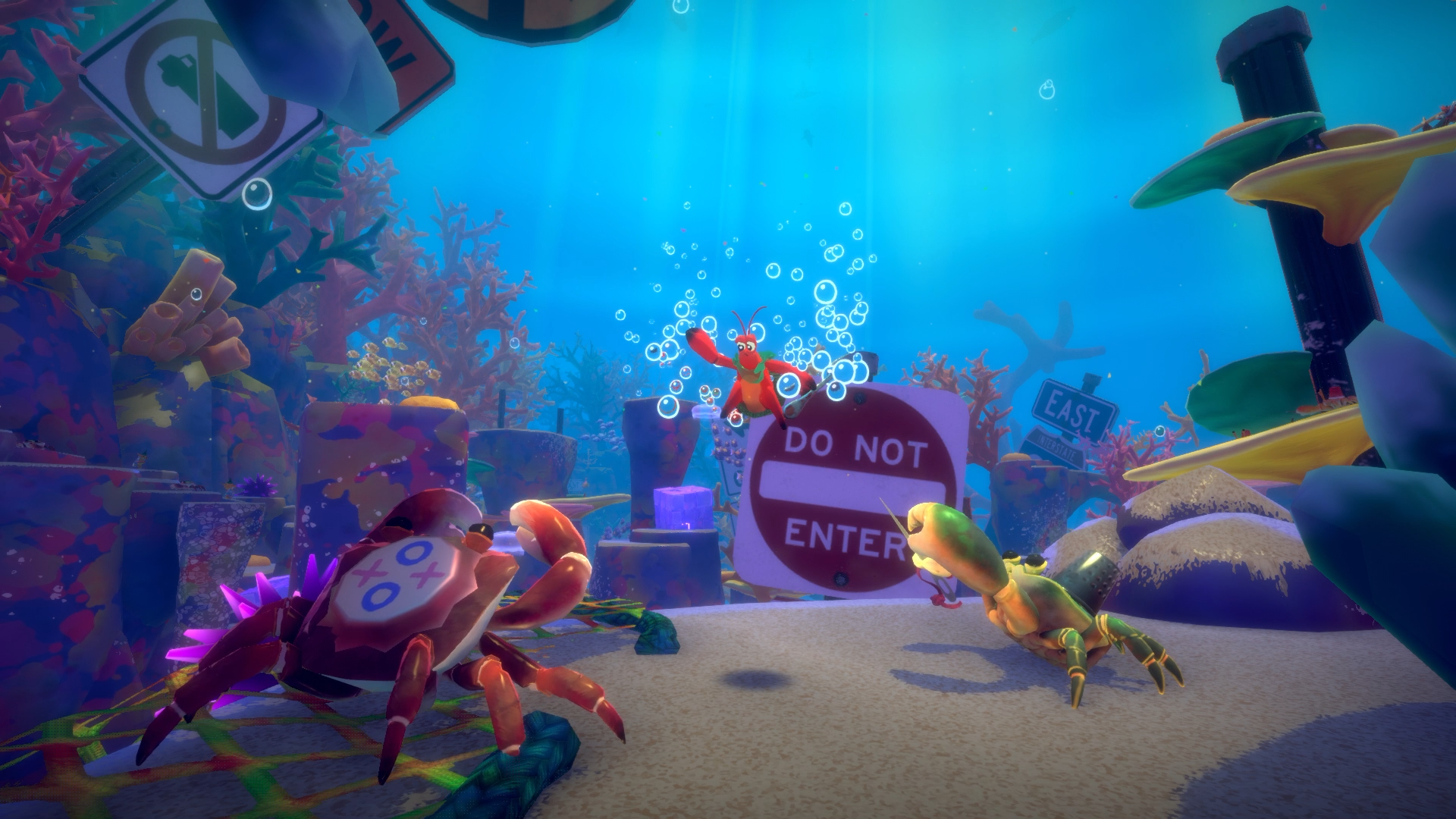
Setting out into the wild blue yonder is constantly surprising and exciting. Dangers lurk around every dune and crevasse, sure, but so too do treasures and power ups. The several biomes found throughout the game are unique and compelling in their own way — though I could have done without the traditional poison swamp. Something that constantly earned a smile of appreciation is the hand-drawn world map. It’s gorgeous, and I loved scouring every detail to admire its interpretation of the landscape. It also helped clearly mark my discovered Moon Snail Shells — the game’s version of a bonfire that let me teleport instantly back to merchants or other levels.

With more polish, Another Crab’s Treasure might have been an all-time indie gem. Its sometimes tedious physics and less-balanced early bosses don’t overshadow the game’s beautiful world, creative levels, sincere cast, and thoughtful themes, but do pollute the otherwise sparkling water.
I recommend this game to:
- Soulslike fans
- Narrative seekers
- Absurdity lovers
- People who stop to read the silly made-up brands in games
- Tax evaders
- Those in need of a laugh and a scream
- Anyone who has ever felt like fighting back against an unfair world

Leave a Reply to This Week In Indies: May 13 – May 17 – The Indie InformerCancel reply