
Developer Thunder Lotus • Publisher Thunder Lotus • Release 2026 • Platforms PS, Xbox, PC
Thunder Lotus is doing it again. After breaking our hearts with a hug in Spiritfairer, the team is ready to thrust me into a world of messy relationships, glorious visuals, intriguing gameplay, and heavy decisions in At Fate’s End.

Like any good love story beginning, I spotted At Fate’s End from across a crowded room. Seeing one station open, I rushed over, thanking my luck. And it was luck, because it was nearly impossible to get near the indie later in the day — a problem I might have contributed to by loudly proclaiming it my likely game of the show to anyone I met.
Truthfully, it wasn’t my first time seeing the game, or rather, its trailer. That happened last year at Summer Game Fest, meaning I was forewarned about its potential. So, when I saw a hands-on opportunity, I was ecstatic.
Love is as much a source of pain as joy in At Fate’s End. Our heroine, Shan, has lost her mother. The matriarch of the legendary Hemlock clan doesn’t depart the world quietly, though. She sets the fate of her youngest daughter, her entire family, and the entire realm on its head when she secretly reveals to Shan that she is the heir to the clan. But to earn her place and claim the title of Princess of Swords, she will have to gain her siblings’ fealty, by rook or crook.
The physical manifestation of her family’s loyalty is their swords. Each member of the Hemlock line has taken up a knighthood defined by the magical swords they’ve chosen to wield. Shan’s sword, called Aesus, grants her abilities even she isn’t fully aware of yet. And because its function isn’t immediately apparent, some of her siblings doubt its strength, and thus, Shan’s.

Celtic folklore inspired the game’s deep narrative. Fans of that mythology might know that power always demands a price, and there are rarely happy endings. For example, every one of the legendary swords require their bearers to make a serious sacrifice before conferring on them otherworldly abilities. To wield Aesus, Shan scarficed her throat. This portion of her body sits transparently below her head, and its absence means she’ll never be able to use her own voice again. Consequently, Aesus speaks for her.
Looking at how much the knights give up, it would seem like a difficult task to convince anyone to pledge their swords to another. However, things get so much more complicated when the twisting family dynamics of a legendary clan come into play. Shan’s siblings all suspect they should probably be the rightful heir in one way or another, so she will have to find a way to convince them of her claim.
This is where we meet Shan’s older sister, Camilla, in the preview. She is a lion of a woman whose battle lust and exuberant spirit walk hand in hand. She exalts in meeting again with her long-absent little sister. And with the same enthusiasm, she launches into combat with her. Camilla sacrificed her left arm in order to gain the fierce blade on her hip, and won’t give up her place easily.
The emotional reunion spills quickly into battle. Initially, combat seems pretty straightforward for an action RPG. Jump, swipe, and study your opponent’s attack patterns until you know when and where to hit. However, Shan’s secret sword powers open up more options.

At Fate’s End’s structure is intertwined with tarot — you might have caught that from the heir’s title: Princess of Swords. The interface for Shan’s powers takes the form of wonderfully elaborate cards. In the case of this fight, the sword draws from her opponent’s strengths, giving me the option to add to my deck a card representing a double jump or a dash power. These possibilities, it seems, will change depending on the fight, making every encounter unique.
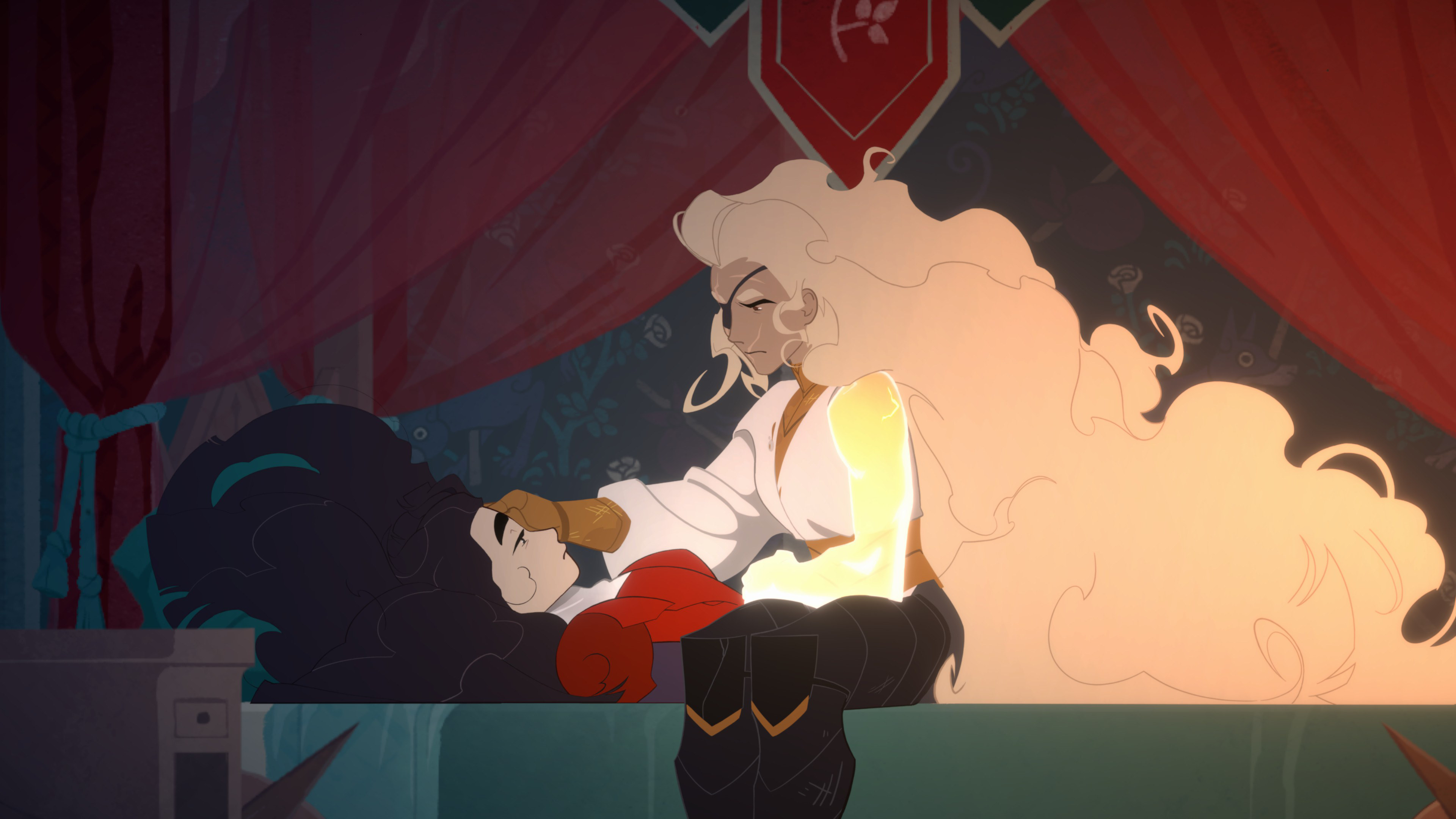
But I’m not really ready to beat Camilla. Even if I could best her in combat, she wouldn’t accept Shan as heir just yet. And because she’s not ready to accept Shan, I can’t beat her. The battle ends with my seeming death before I open my eyes to Camilla watching protectively over me in bed. Families are complicated.
To find what I need to earn my place, I head to the lands directly under my sister’s control to learn anything I can to convince her to believe in me. The game transforms into an adventure sidescroller in which my objective is to search for clues using my sword’s unique powers of observation.

With a little room to breathe and take everything in, I become completely enraptured with the game’s art. It’s rich and stylized like manuscript illustrations of long-passed-down legends. Even the most mundane animations, like Shana thoughtlessly twisting her thick hair over her shoulder, command attention and admiration. The color palette caresses the screen.
Wandering my sister’s castle halls, I switch between my normal sight and — what I’ve decided to call — Sword-O-Vision. Through this magical lens, I can see icons hovering over certain objects that, when clicked, give me important insight. In one place, I might see scorched bedding left in tatters that speaks volumes of my sister’s less-than-serious care for her domain. I might also use this special vision to uncover secrets, like hidden markings that grant me experience points.
Anytime I find something significant, a tarot card appears in my inventory. If this were a detective game, these cards would be pinned up on a corkboard full of red string because they are essentially clues. Traipsing through sconce-lit passage way and unkempt gardens, I collect cards, then jump into my menu to see if I can put them together in a way that will help me confront Camilla.
This is the difficult part of the game. Not collecting clues or fighting, it’s having to go back to my sister with a hard truth. Going back to the field of battle, once I whittle down Camilla’s health enough, it triggers a phase where I have to choose how to speak to her so she will listen. If I accuse her of crimes, will it break down her resolve? If I try to empathize, will she see that as condescension? It’s these decisions, as much as the combat, that win the fight.

I’m happy with how my choices turned out as the demo comes to a close, but I can see future battles with less friendly siblings becoming gut-twisting dilemmas. Family drama, after all, is complicated and nuanced, and I’ve never seen it so tangibly present in a game as it is in At Fate’s End. I can’t wait to turn the next page on this tale.

Leave a Reply