
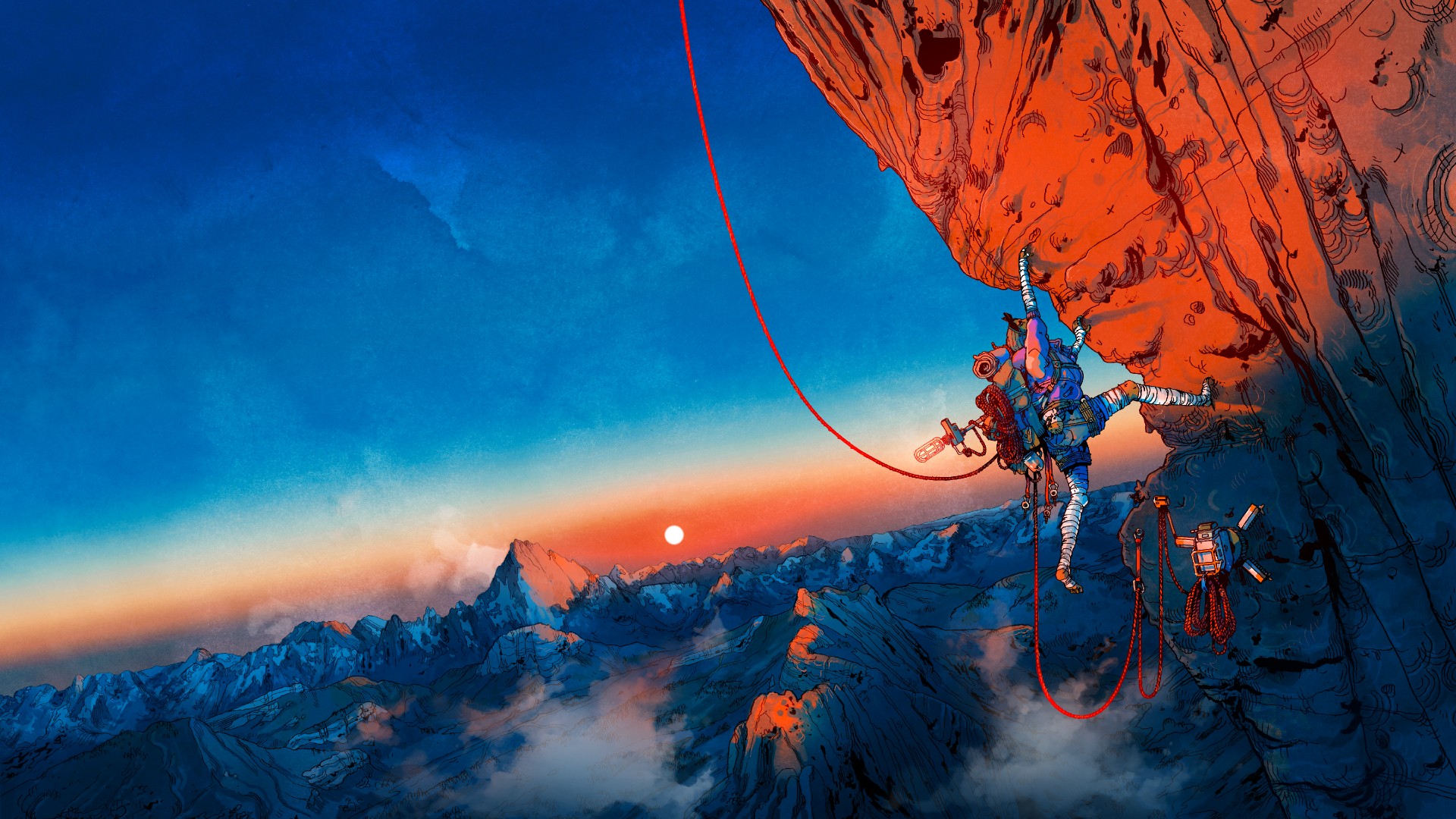
Developer The Game Bakers • Publisher The Game Bakers • Release January 29, 2026 • Played On PC
Sometimes, the best things in life only come to you when you’re willing to stick with it and be patient. The opening hours of frustrated learning in Cairn slowly yield to a beautifully meditative experience. A fascinating mix of QWOP and Journey, Cairn is all about soaking in the moment. And a sweet reminder of the old adage that the journey is more important than the destination.
The easiest way to describe Cairn is as a narrative-driven rock climbing simulator. And the emphasis should be on the simulator part, as Cairn is quite a bit more complex than you might expect.

Cairn follows world-renowned pro-climber Aava as she takes on the deadliest task of her career, the ascent of Mount Kami. This massive mountain’s peak has never been reached, although dozens of climbers have lost their lives in the process. Outside of that brief setup, Cairn gives you shockingly little about Aava and the world itself to work with, at least initially.
The threads of Aava’s life, relationships, and past start to come together as she ascends the mountains, getting messages from those she’s left behind on the ground via her Climbot companion. These are brief, but important, reminders of the world outside Aava’s desperate and lonely struggle against the mountain.
In a roundabout way, it feels like the most apt way to describe Cairn is as one continuous boss fight — your will against the mountains. Everything in Cairn is methodical, from how you view the environment and pick your route, to the way you move your limbs in a QWOP-like fashion, struggling for handholds and cracks to grab onto.

You can climb on any surface at any time, and can only move one of Aava’s limbs at any given moment. The game has a setting that auto-selects the best limb to keep you climbing efficiently, but you can also manually select which one, if you have a better plan. And I can legitimately say this is the most complex climbing simulation I’ve ever seen in a video game, clearly built by developers who have a real appreciation for it.
There’s so much complexity baked into each and every facet of the game, it’s not just about finding the next handhold. You need to look at the position of each rock and wall, use Aava’s body and posture to prop her up when there’s not a crack to grab onto, manage your stamina, temperature, hunger, and more.
Save spots scattered across the mountain let you prop up your bivouac, a little tent where you can cook food to restore hunger, thirst, and heat up. You can also wrap your fingers for a better grip, repair your pitons so you can drill them into the mountain for a rappel point, and sleep to recover health. In addition to the sheer climbing experience, you’ll need to manage all these facets, while also scavenging for supplies in abandoned buildings and camps.

And while the actual climb is a nail-biting moment-to-moment rush, the in-between of all that is really when you get to soak in the beauty of Cairn’s world. It’s when you understand the intricacies of Aava’s job as a climber, and how she uses it as a crutch. You learn of her strained relationship with her sister, the frustrations of her agent when she goes completely off the grid for weeks at a time.
As I clambered through the weaving peaks and tunnels of Mount Kami, I discovered the remnants of an indigenous people known as Troglodytes, who live “vertical” lives, climbing from childhood. There are bits on their religion and lifestyle, but all these habitats are eerily abandoned. As you dig further into the game, you start to learn why, because of how the mountain has been mythologized and inundated with adrenaline-seeking climbers. There’s a rich story to uncover, on multiple levels, but equally engrossing are the delightful little moments you uncover.
In one cave, I found a frog and perhaps unwisely licked it, sending me into a rainbow-colored drug trip. In another, I found the site of a secret rave complete with fireworks, which, at the nest peak, I used to give myself a private show.

The first few hours of Cairn can be exceedingly frustrating, as you struggle to figure out the intricacies of the climbing system, how to restore your stamina in the middle of a climb properly, and more. The handful of times I fell were dispiriting, at first. But Cairn is a game of patience, about learning the game’s unique language. After a few hours, I started recognizing little cracks and visual spots on the walls for handholds that I hadn’t noticed before. I knew just the right way to maneuver Aava’s leg to reach a far-off spot. And I knew where I’d be likely to find water spots to fill up my bottles.
The further you get in Cairn, the more you start to feel like a pro climber yourself, and more importantly, start to find joy in not just the beautiful sites and discoveries, but the climb itself. Any frustrations I had slowly started to melt away, and even falls and death were learning moments where I could put together a better plan — like discovering the moveset of a Soulslike boss. The way Cairn grows alongside the player is remarkable, both in terms of that core simulation and its narrative complexity — as you learn to become a better climber, you understand Aava herself more. What initially felt nerve-wracking and frustrating becomes meditative.
And perhaps Cairn‘s most important message is a reminder of the power of committing time and patience, how far you can go when you’re willing to commit, wholeheartedly, to something. And the importance of getting back up and trying again when you’ve fallen to literal rock bottom.

Leave a Reply